Client stakeholder
Holds real success criteria — not always what's in the brief. Will remember how you showed up.
DECISION SIMULATION · TEAM FORMAT · 10–40 PLAYERS
How do you protect the relationship, hit your internal targets, and still respect the delivery team that's counting on you?
Quick answer
68%
of relationships that end cite "unmet expectations" — rarely unmet delivery
3×
time spent managing scope creep vs. preventing it
1
conversation that could have prevented most crises — often skipped in week one
Most client failures are communication failures that started long before anything went wrong.
Client management training often covers negotiation or expectation-setting. Neither fully addresses the moment when a client asks for something you can't deliver without hurting another priority — and you must decide in real time what to say.
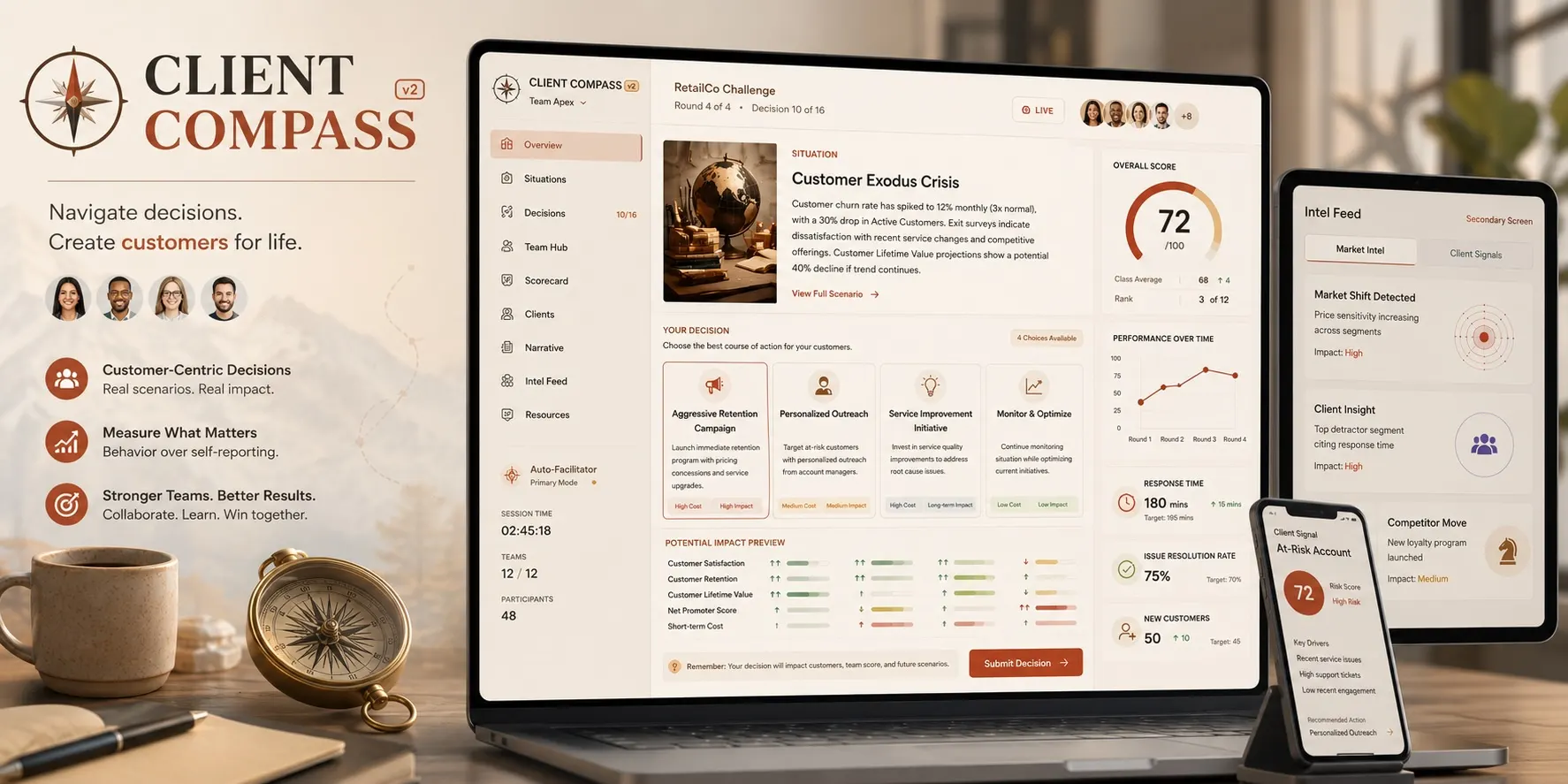
Client Compass runs that moment across delivery phases. The client evolves; requests shift; internal constraints don't flex to match. Each decision shapes the relationship, the team, and the outcome.
Structured phases keep energy and learning tight — from brief through play to debrief.
Phase 1
The team receives the brief and internal targets — not yet seeing tensions inside the client's priorities or hidden commitments elsewhere.
Setup · Hidden constraints
Phase 2
Requests arrive — accommodate, negotiate, or hold position. Trade-offs hit client satisfaction, team morale, and timeline simultaneously.
Competing pressures
Phase 3
Review meeting: the gap between promise and landing — and whether the client saw it coming.
Trust inventory
Consequence: Morale drops; scope creep becomes the norm.
Consequence: Healthier boundary; relationship stays honest.
Consequence: Short-term tension; may protect delivery integrity.
Holds real success criteria — not always what's in the brief. Will remember how you showed up.
Knows true capacity; may resist the client indirectly through you.
Sits between relationship and delivery — carries both pressures simultaneously.
Signed the deal; cares about margin — often absent until something breaks.
Makes trade-offs visible while the story unfolds — satisfaction, delivery, trust, morale.
Client satisfaction
0–100
Internal milestone achievement
% on track
Relationship trust
Index
Team morale
After overtime / avoided conversations
Always accommodates — short-term satisfaction, long-term delivery strain.
Protects internal targets — delivery may land, relationship may not renew.
Early honesty, fair negotiation — repeat-client pattern.
Vague commitments — reckoning at review.
A team-based simulation where participants navigate evolving client requests, internal constraints, and relationship risk across delivery phases. Each choice updates relationship health and delivery outcomes.
Expectation-setting, scope discipline, proactive communication, and how teams trade off client satisfaction against delivery reality — surfaced as mindset profiles for debrief.
Account management, client services, consulting, and delivery teams where scope creep and silent misalignment erode margins. Especially useful before major client transitions or QBR seasons.
Book a facilitated session — we'll match group size, format, and outcomes to the right simulation.