Volume trend
Week-on-week activity — baseline health.
DATA SIMULATION · INDIVIDUAL + TEAM · 10–50 PLAYERS
Not only what you decide — when you decide, and what you let pass while waiting for certainty.
Quick answer
74%
of executives want more data before deciding (MIT, 2024)
38%
miss the optimal window waiting for it
20
weeks — each with a cost to waiting
It rewards the player who knew when the data was good enough — not the most analytical deck.
Data literacy teaches how to read dashboards — rarely when to stop waiting and act.
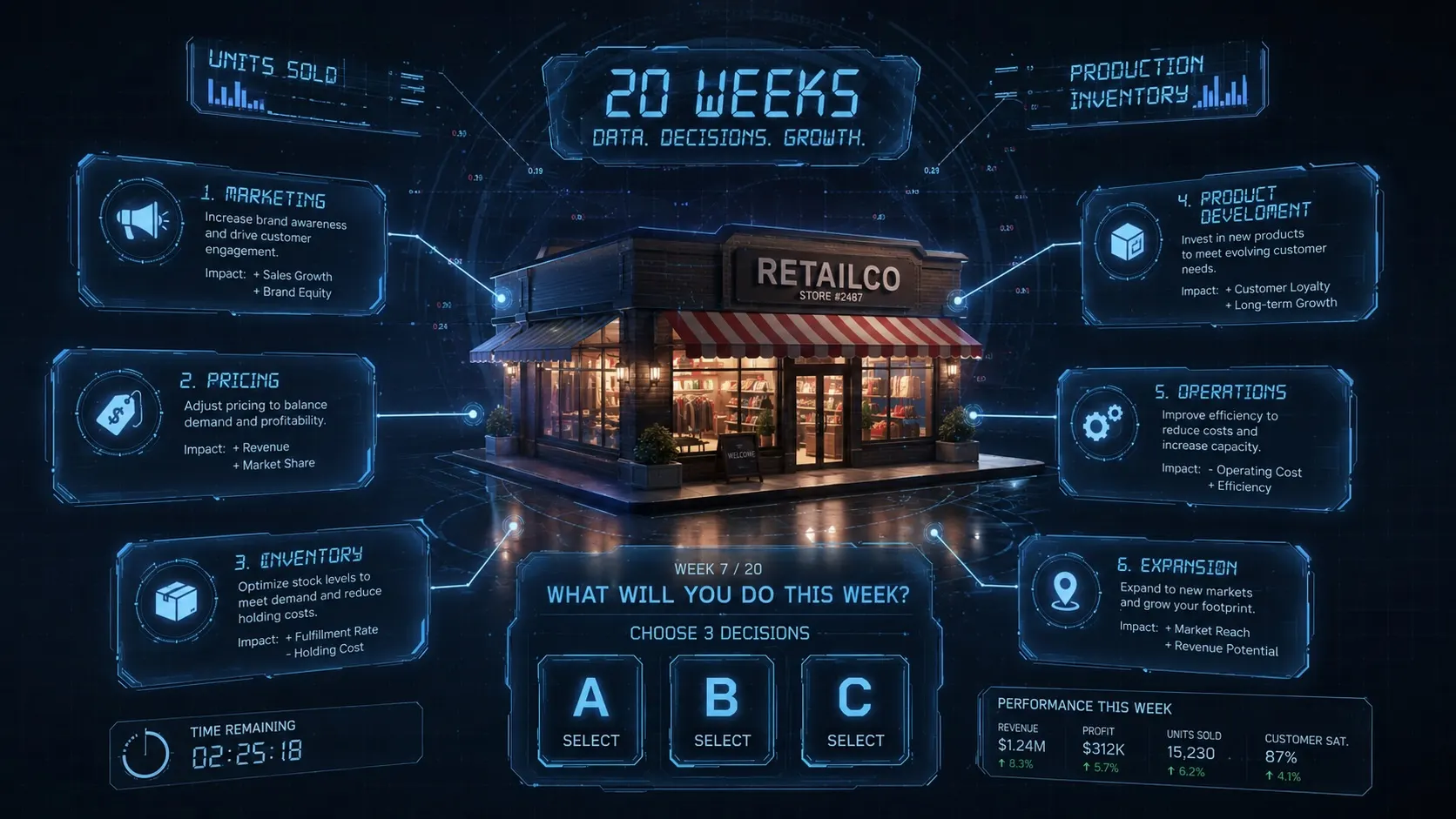
20 Weeks pairs live data, fixed targets, and twenty sequential weeks. The window narrows; timing is scored alongside accuracy.
Structured phases keep energy and learning tight — from brief through play to debrief.
Block 1 · W1–5
Sparse data, ambiguous trends — expensive quiet if nobody moves.
Signals easy to miss
Block 2 · W6–10
Divergence appears — act now or rationalise it away until week 15.
Act or wait
Block 3 · W11–15
Targets at risk — measured recovery beats reactive lurches.
Cost of lateness
Block 4 · W16–20
Final levers — individual report on decisions, timing quality, and optimal path comparison.
Outcome report
Consequence: Optimal window can close by week 14.
Week-on-week activity — baseline health.
Leading pipeline signal — easy to underweight early.
One-off events that may or may not matter.
Market signal often ignored until too late.
Qualitative ground truth — competes with charts.
Target achievement
% weekly hits
Decision timing
Early / on-time / late
Signal response rate
Speed on detectable shifts
Recovery cost
Ground lost to late corrections
Waits for certainty — misses windows.
Acts early — high variance, occasional brilliance.
Threshold rules — consistent.
Waits, then swings big — penalised.
A facilitator-led data simulation where participants interpret shifting metrics across twenty weekly rounds and decide when to intervene. The design measures timing and conviction under incomplete information — not spreadsheet accuracy alone.
Project leaders, product owners, and operational managers who delay decisions while waiting for certainty. Common cohorts include PMO communities, transformation teams, and leadership programmes building execution discipline.
Decision timing, signal versus noise discrimination, escalation judgement, and team alignment when data is ambiguous. Debrief maps patterns to real roadmaps, stakeholder updates, and incident response.
Most enterprise sessions run two to two-and-a-half hours including briefing, simulation rounds, and facilitated debrief. Virtual and in-person formats are available.
Book a facilitated session — we'll match group size, format, and outcomes to the right simulation.