Commander
Final exploration calls; holds the mission brief.
FLEET SIMULATION · 6 TEAMS · 10–60 PLAYERS
Six teams share a fleet with a common survival goal and competing glory metrics. Every team chooses: go farther and risk everything, or conserve and trust someone else delivers.
Quick answer
73%
of leadership teams cite resource constraints as their #1 strategic pressure
4×
cost of over-extending vs. holding position in ambiguous conditions
6
teams in the fleet — six interpretations of “we're all in this together”
The simulation doesn't tell you to collaborate. It shows what happens when you don't — and lets the maths argue.
Most resource training focuses on prioritisation frameworks. They rarely capture another team making a live decision that affects yours without asking.
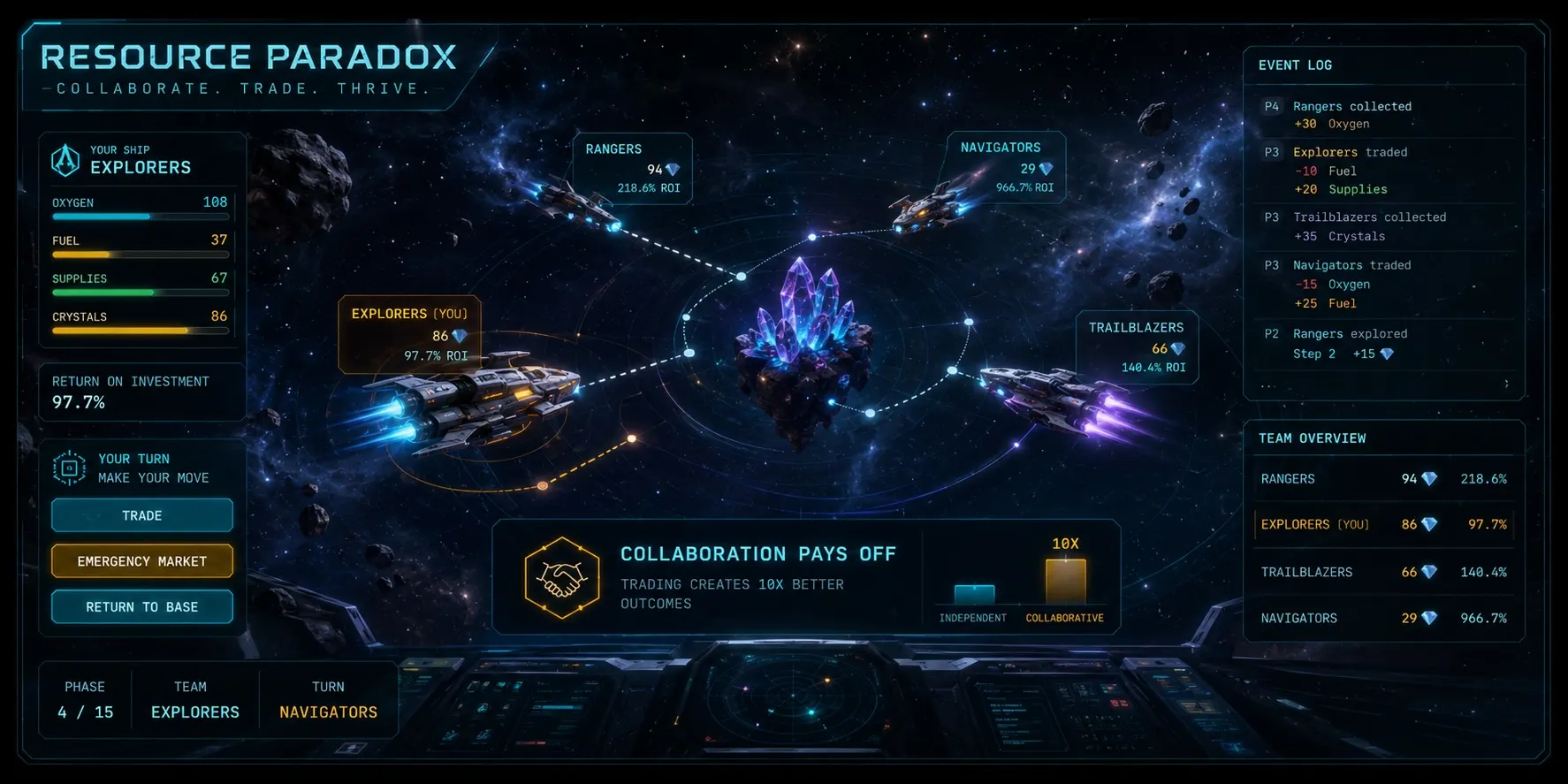
Resource Paradox runs six teams in one fleet: shared survival, competing glory. Explore deeper for a better find — or conserve and hope rivals deliver? The answer changes by round three.
Structured phases keep energy and learning tight — from brief through play to debrief.
Phase 1
Fleet briefing, maps, first exploration choices. Everything still feels like preference — constraints haven't bitten.
Abundance mindset
Phase 2
Resources fall; some teams strike deposits; collective survival threshold becomes visible. Transfer requests open — often too late.
Scarcity · Coalitions
Phase 3
Last push: full commitment wins the leaderboard; conservative play may keep the fleet alive. Debrief names which optimiser the room chose.
Reckoning
Consequence: Miss and you may strand the mission and teams you didn't help.
Consequence: Builds fleet survival; lowers your headline score.
Final exploration calls; holds the mission brief.
Route map and sector risk — information others lack.
Live fuel and supply — sees true depletion rate.
Broadcasts and transfer requests; decides what's shared.
Deposit probability — data holder, not sole decider.
First to know when trust across teams frays.
Fleet survival
Collective threshold
Team resource level
Fuel / supply
Individual team score
Deposits vs. peers
Collaboration index
Transfers & responses
Never transfers; may survive alone while the fleet bleeds.
High variance — boom or bust; makes the conversation.
Reads the fleet board; transfers with intent.
Lets others save the fleet while chasing personal score — gets named.
A competitive-collaborative simulation where teams allocate scarce resources across rounds with partially aligned incentives. Winning locally can lose collectively — the tension is deliberate.
Resource hoarding, silent assumptions about fairness, negotiation under time pressure, and whether leaders protect their unit or optimise for the enterprise outcome.
Cross-functional offsites, leadership cohorts discussing enterprise prioritisation, and teams recovering from siloed planning cycles. Pairs well before OKR or budget conversations.
Book a facilitated session — we'll match group size, format, and outcomes to the right simulation.