Strategist
Owns the horizon: what must be true on day three for day one to make sense?
ISLAND SURVIVAL · STRATEGY VS CRITICAL THINKING
Pressure, incomplete information, and irreversible turns — practise how strategic plans and critical pivots either reinforce or undo each other.
Quick answer
1
incoming tide — wreckage is perishable; delay costs salvage
0
boots → no forest access → different food and cover trade-offs
∞
blocks of time, each a bet: scavenge, build shelter, recover
Better strategic thinking keeps you alive longer on the island. Sharper critical thinking helps you adapt when the plan meets salt water and sand.
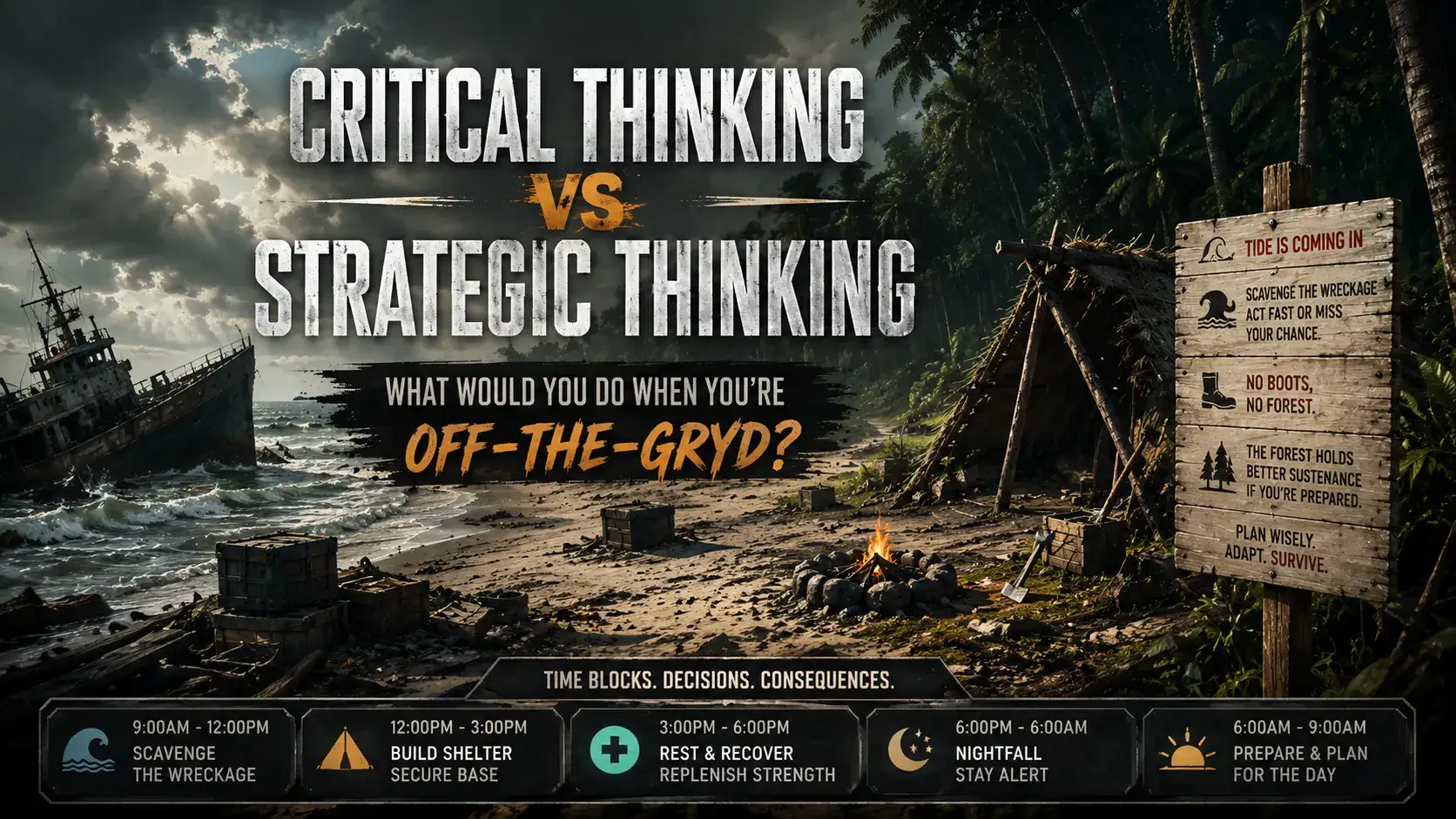
Off-the-Gryd is framed as survival on a deserted island. Signs in the scenario make the pressure legible: the tide is rising, so teams that wait 'for a perfect plan' may lose the window to strip useful gear from the wreckage.
Boots are gating: without them, the forest — where better sustenance might hide — stays off-limits. Every chunk of time is a decision: do you scavenge while you can, invest in shelter, or stop to rest and recover?
The simulation makes the dual skill line vivid on the board: long-horizon sequencing (strategic thinking) vs. disciplined reassessment when assumptions break (critical thinking).
Structured phases keep energy and learning tight — from brief through play to debrief.
Act 1
Brief lands the island rules and the clock: partial map, unclear inventory, and the first scramble — what can you pull from the wreck before the tide takes it?
Pressure
Act 2
Teams allocate time blocks: scavenge vs. shelter vs. rest. Early calls feel reversible until fatigue, weather, and hunger change the math.
Trade-offs
Act 3
Boots, tools, or knowledge unlock the forest path — or don't. Critical thinking shows up as reframing: what did we assume that the island just disproved?
Adaptation
Act 4
Final accounting: survival length, resources, and morale. Debrief links island bets to portfolio calls, hiring, and operational shocks.
Transfer
Consequence: Strategic bet on future turns.
Consequence: Critical if storm signals flip.
Owns the horizon: what must be true on day three for day one to make sense?
Pressure-tests assumptions with what the table actually reveals each turn.
Forces explicit rationale on each time block so the debrief has receipts.
Indices vary by cohort — the pattern matters more than the number.
Days survived
Horizon index
Resource depth
Gear + cover
Adaptation events
Plan revisions that stuck
Crew condition
Rest / injury / morale
A survival-style business simulation where teams face sequential decisions with scarce resources and incomplete information. The design exposes prioritisation habits and leadership emergence when authority is unclear.
Participants cannot analyse their way to certainty. Rounds force commitments before full data arrives, then reveal consequences that compound — training when to act, conserve, or cut losses.
Leadership cohorts, operational teams managing disruption, and groups that need to see real instincts under strain — often after competency assessment flags judgement gaps.
Named patterns — optimism bias, freeze responses, early over-commitment — mapped to budget fights, incident response, and market pivots with concrete behaviour commitments.
Book a facilitated session — we'll match group size, format, and outcomes to the right simulation.